

Published on the World Health Council Substack on April 10, 2026
In the debate over wind turbines, the law of unintended consequences has become all too familiar. Some of these consequences are:
- pollutants in their materials (microplastics, fibreglass, “forever chemicals” such as PFAS and BPA)
- the wrecking of countryside and ancient forest to make way for wind farms — including habitats of endangered species
- birds mangled in the blades
- audible noise pollution and its damage to wildlife (Teff-Seker et al., 2022).
“Planning regulations are yet to address the issue of WTN (wind turbine noise) impact on wildlife, despite accumulated evidence to suggest that anthropogenic noise generally, and WTN particularly, are responsible for actual and potential harm to animals and consequently to ecosystem function.”
—Teff-Seker et al. (2022)
So much for eco-friendly energy.
To add to the growing list of harms, there is another factor at play. Invisible and (largely) inaudible, it is barely acknowledged by planning and regulatory authorities — yet its impacts can be devastating.
That factor is infrasound.
Facts about infrasound
Infrasound refers to sound waves with frequencies below 20 Hz. These are usually inaudible to humans, but at high intensity they can be perceived in the body as physical pressure or vibrations.
Wind turbines emit these waves as pulsations (in contrast with nature, where infrasound is continuous). These pulsations, which are described by Professor Ken Mattsson as “periodic explosions”) can result in symptoms that include sleep disturbances, migraines and a sensation of motion sickness.
The advocacy group Motvind has distilled current findings into an infographic:
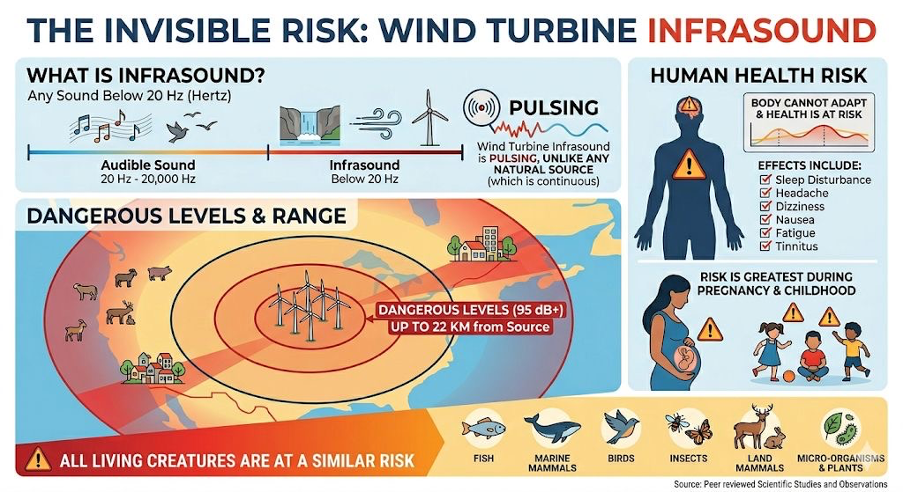
Tim Smith, a farmer in Wales, has formed a UK branch of Motvind. In 2024, he spoke with Dr Tess Lawrie about his deep concerns regarding wind farms: the devastating effects on fauna (including bizarre behavioural disturbances) and subsequent desertification of local ecosystems. Dr Lawrie also notes:
“I learned that worms are particularly sensitive to turbine vibrations and rapidly vacate land with wind turbines; thus farmers who choose to farm turbines and not food leave a legacy of incomparable destruction for the land itself. Even if the turbines were to be removed in due course, which given their size and non-biodegradable materials would be extremely difficult, it would take generations to restore the land to productivity.”
Opening the debate — could the winds be changing?
Grim as the outlook seems, there has recently been very real progress in the battle against wind farms — and on infrasound specifically. As Tim Smith says: “Things have moved on with the turbine fight and we have peer reviewed scientific papers on the propagation of and harms from wind turbine infrasound. The authors presented their findings at the EU Parliament last month.”
i) The evidence exposed: what published papers are showing
Christian Vahl, a cardiologist and medical professor from University of Mainz in Germany, has published extensively on infrasound, though many websites featuring his work are no longer accessible. Years earlier, using samples of heart muscle, he and his team showed that just one hour of high-level infrasonic exposure can significantly reduce cardiac contraction function — and that the effects of infrasound would “involve a wide range of process, like calcium metabolism and mitochondrial integrity” (Chaban et al., 2019). In a 2020 interview, Professor Vahl emphasised how “infrasound is not an esoteric phenomenon, but a biophysically measurable effect that must be taken seriously.”
More recently, a study by Dastan et al. (2026), which explores therapeutic dose-dependent applications of infrasound, concludes that:
“Infrasound can travel long distances with minimal attenuation and permeate biological tissues due to its marked particle displacement and deep penetration […] responses vary according to sound pressure levels, frequencies, exposure duration and tissue type […] In animal models, prolonged or intense exposure to infrasound has been shown to induce neuroinflammatory responses and memory impairment […] Overall, existing data indicate that infrasound may be harmful at chronic exposure depending on intensity and frequency, yet beneficial when precisely regulated.”
So if the dose makes the poison, the findings by Mattsson et al. (2026) are particularly damning:
“The results show that modern, large-scale wind turbines generate infrasound levels significantly higher than those reported for older, smaller turbines.”
Ken Mattsson, a professor of scientific computing from Sweden, was among the infrasound researchers who presented their findings to the European Parliament in March 2026. In an interview later that day with MEP Fernand Kartheiser, he explained:
“Building these new wind turbines 600 metres from where people live is not a safe distance. And besides infrasound, you also have this audible sound which can be very annoying also … and at the level of 60dBA, it’s quite high and this amplitude modulated sound can propagate 10km. And it’s very disturbing because it’s pulsating, and this of course affects all kinds of living organisms […] Horses move away as far as they can from the noise and they refuse to come back home because it’s closer to the wind turbines.
“I talk to authorities responsible for noise in Sweden, and they don’t want to listen to the facts, and they still claim that ‘if you can’t hear it, it can’t harm you’ and it’s almost impossible to reach them.”
Regarding the environmental damage of offshore wind turbines, he continues:
“They’re much larger so of course they emit lots of infrasound in the air. And over water it propagates much further, but it also propagates lots of infrasound in the ocean… and lots of marine life communicate with infrasound.”
Nonetheless, he gives overall grounds for optimism:
“I think that the atmosphere is a little bit more open to discuss this. Ten years ago, this was ‘no, don’t go there.’ But now, the winds are a little bit changing, I feel that.”

ii) Litigation victories: the French precedent
Public pressure has resulted in some successful challenges in court, forcing regulatory bodies to rethink permissions and regulations. These include the following French lawsuits:
- In March 2024, France’s highest administrative court, the Conseil d’État, ruled that the government had acted unlawfully in its approval of a wind turbine noise-measurement framework, as it had skipped the legally-required environmental assessment. The judgement means the rules have to be properly redrawn, thus putting planned installations under extra scrutiny and delay. Hence, where governments display an obdurate determination to accelerate wind farm development at all costs, the judicial system can –sometimes– provide the necessary restraint.
- In November 2025, a retired teacher successfully sued in Strasbourg for damage to her health, caused by the installation of wind turbines near her home in Somme. Although the ruling in her favour was technically based on angoisse (i.e. stress and anxiety, which the court agreed had been caused by the turbines), she had a range of physical symptoms consistent with infrasound exposure: dizziness, tinnitus, sleep disorders. Tests on her house revealed high infrasound levels, which insulation was unable to prevent. The audible noise and flashing light would not have helped either.
“Angoisse has been recognised since 2017 in French law as something which can be pursued in court if caused by the actions of another. It was on this basis that we won the case […] I have similar cases from all over France. Now that one court has found that wind turbines can cause angoisse it sets a precedent which can be used as an argument in other cases.”
—Maître Philippe Bodereau, lawyer in the Strasbourg case
The signal among the noise
Concerns regarding wind farms and infrasound can no longer be mockingly dismissed as flimsy fringe science. Emerging biological evidence shows that regulatory frameworks based on obsolete assumptions, scientific laziness, ideological stubbornness and vested interests are, frankly, not fit for purpose. When plausible mechanisms for harms exist, the burden of proof cannot indefinitely be dumped onto the victims.
Invisible and often inaudible, infrasound is far from inconsequential. We all need to take it very, very seriously, and give it a prominent focus in the increasingly compelling case against wind farms.
World Council for Health stands for a Better Way
References
BBC News. (2024, November 15). Appeal against wind farm ruling thrown out. https://www.bbc.co.uk/news/articles/cy5l92y4p1zo
Chaban, R., Ghazy, A., Buschmann, K., Vahl, C. F., & Schnelle, N. (2019, March). High level infrasound exposure reduces the contractility of human cardiac tissues in in-vitro model [Poster]. Deutsche Gesellschaft für Chirurgie, ID 410, Poster-Nr. DGCH-13. https://www.researchgate.net/publication/339080917_High_level_infrasound_exposure_reduces_the_contractility_of_human_cardiac_tissues_in_in-vitro_model
Conseil d’État. (2024, March 8). Décision n° 465036. https://www.conseil-etat.fr/fr/arianeweb/CE/decision/2024-03-08/465036
Dastan, M., Ribeiro, E. D. P., Bellut-Staeck, U., Zhou, J., & Lehmann, C. (2026). Infrasound and human health: Mechanisms, effects, and applications. Applied Sciences, 16(3). https://doi.org/10.3390/app16031553
Kartheiser, F. (n.d.). Podcast avec Ken Mattsson : santé publique et infrasons issus de l’énergie éolienne dans l’UE [Video]. Facebook. https://www.facebook.com/reel/2497485887389456/
Kirschstein, G. (2020, May 11). Explosive Mainz study: Infrasound of wind turbines can significantly damage human heart performance. (Translated from German.) Mainz&. https://mainzund.de/brisante-mainzer-studie-infraschall-von-windraedern-herzleistunug-vahl/
Lawrie, T. (2024, November 17). Wind farms and the climate hoax. A Better Way with Dr Tess Lawrie. https://drtesslawrie.substack.com/p/wind-farms-and-the-climate-hoax
Mattsson, K., Eriksson, G., Persson, L., Chilo, J., & Tatar, K. (2026). Efficient finite difference modeling of infrasound propagation in realistic 3D domains: Validation with wind turbine measurements. Applied Acoustics, 243. https://doi.org/10.1016/j.apacoust.2025.111156
McCulloch, B. (2026, March 6). French court ruling may open way for cases against wind turbines. The Connexion. https://www.connexionfrance.com/news/french-court-ruling-may-open-way-for-cases-against-wind-turbines/768624
Motvind Norge (homepage). https://www.motvind.org/
Teff-Seker, Y., Berger-Tal, O., Lehnardt, Y., & Teschner, N. (2022). Noise pollution from wind turbines and its effects on wildlife: A cross-national analysis of current policies and planning regulations. Renewable and Sustainable Energy Reviews, 168, 112801. https://doi.org/10.1016/j.rser.2022.112801
The Telegraph. (2024, November 25). Golden eagle killed after flying into wind turbine. https://www.telegraph.co.uk/news/2024/11/25/golden-eagle-dead-wind-turbine-scotland-dumfries-galloway/
World Council for Health. (n.d.). Wind turbines: the hazards of wind turbine blade debris. https://www.worldcouncilforhealth.org/wind-turbines-health-effects


Wind Concerns is a collaboration of citizens of the Lakeland Alberta region against proposed wind turbine projects.
I live in SW Scotland and have been suffering the ill effects from wind turbines for the last 16 years. It started with waking from nightmares to the reality of the physical force of the regular thump of the turbines. Dizziness when I got up to walk about. As ther numbers of turbines and wind farms increased, my property was surrounded by 200 turbines within a 4 km range and latterly by several outer rings, the vibrations of which have been measured by equipment installed in my house for that purpose.
The effect of these and their increasing size has had a devastating effect on my quality of life. Additional problems have developed, excrutiating pains in my ears which move from ear to ear when I turn through 180 degrees,
sickness and diarrhorea.
When I leave home for a while everything becomes normal again – except for one time when I inadvertantly booked a hotel opposite a wind farm!
As a professional musician and music publisher, I also suffer from being forced to play music at the speed of the turbines, or half or double their speed.
Having successfully fought and prevented a new wind farm on my neighbour’s land 8 years ago when the local council had control and instructed that no further applications should be made for that area, the scoping has been done and a new application is about to go in – directly to the Scottish government! We should NOT have to fight these battles more than once!
What a terrible situation, Pat. It should be illegal by now. The evidence of the harm of infrasound is mounting, and mounting fast. Regulators are continuing to ignore it because infrasound is the lynch pin to take down the industry. The harm to animals, marine life, and humans can no longer be ignored. Soon, we pray…
As if the human and animal health concerns with wind turbines aren’t bad enough, I think we have another beast incoming – AI data centres! Just watched a podcast revealing the constant “thrumming” and pulsation from their external cooling systems are causing devastating health effects for people living in nearby residences. People can put their hands on the walls and actually feel the vibration in their homes! When will so-called progress be called out for the impact on human health? Can a balance be achieved?
Hi Maureen,
When children are taught in school that they are merely highly-evolved particles of random matter, and those kids grow up to be adults who make adult decisions… then you have our situation today: “adults” who see profit and “progress” as more important than human lives.
Infrasound can take many forms, from pulses emitted from wind, volcanoes, avalanches, earthquakes, wind turbines, and now apparently, AI data centers. It’s the man-made and preventable ones that we have choice over… but finding politicians who are willing to put people ahead of profit or careers these days is very, very difficult.