

In a move to give Alberta municipalities a little more say over how close renewable energy facilities can be erected to human dwellings, the Alberta Utilities Commission (AUC) announced that it is standardizing setbacks for solar and wind projects.
The sudden shift in planning authority, revealed on April 24, 2026, is likely a delayed response to the growing clamor from Alberta rural communities, which have been increasingly assaulted by massive renewable projects. “It’s getting serious,” said Paul McLauchlin, then president of the Rural Municipalities of Alberta, some four years ago. “People are really upset. It’s tearing communities apart.”1

That clamor led, a year later (August, 2023), to a six-month “pause” in the Commission’s approval of renewable projects. According to their press release at the time, the moratorium was intended to address “concerns raised from municipalities and landowners related to responsible land use and the rapid pace of renewables development.”
After the pause, Premier Danielle Smith appeared on CBC, declaring:
Albertans have been vocal that they don’t want large-scale developments to interfere with our province’s most beautiful natural features. You cannot build wind turbines the size of the Calgary tower in front of a UNESCO World Heritage site; or on Nose Hill; or in your neighbor’s backyard.
Premier Danielle Smith, Press Conference, February 28, 2024; YouTube
Rural Albertans were left holding their breath, wondering how, practically, this would be resolved.
The “New” Standards
Until now, the AUC had allowed energy proponents to establish their own setbacks, so long as they fell within the AUC’s 800m – 1500m “noise” guideline range in Rule 012. But now the Commission will allow municipalities themselves to codify in their land use bylaws a pre-determined setback, but within the same range.
Where a municipality sets setback distances in its land-use planning documents, and the setback distance falls within the approved minimum and maximum ranges, the AUC intends to accept and apply those setbacks in future facility application decisions in that municipality…. The maximum setback reflects the 1.5-kilometre noise receptor review distance already used under Rule 012… The minimum setback [800m] is based mainly on noise requirements in established AUC Rule 012.
“Proposed Standardized Setbacks for Renewable Infrastructure”, media.auc.ab
In other words, the municipality will not be overridden by the Commission, something that was happening too frequently.
For any rural residents hoping the AUC would push industrial wind turbines — increasingly taller, noisier, and environmentally damaging — even further away from their homes with an increased maximum range, this new directive may provide little comfort. However, the AUC’s new directives could prove crucial for some communities.
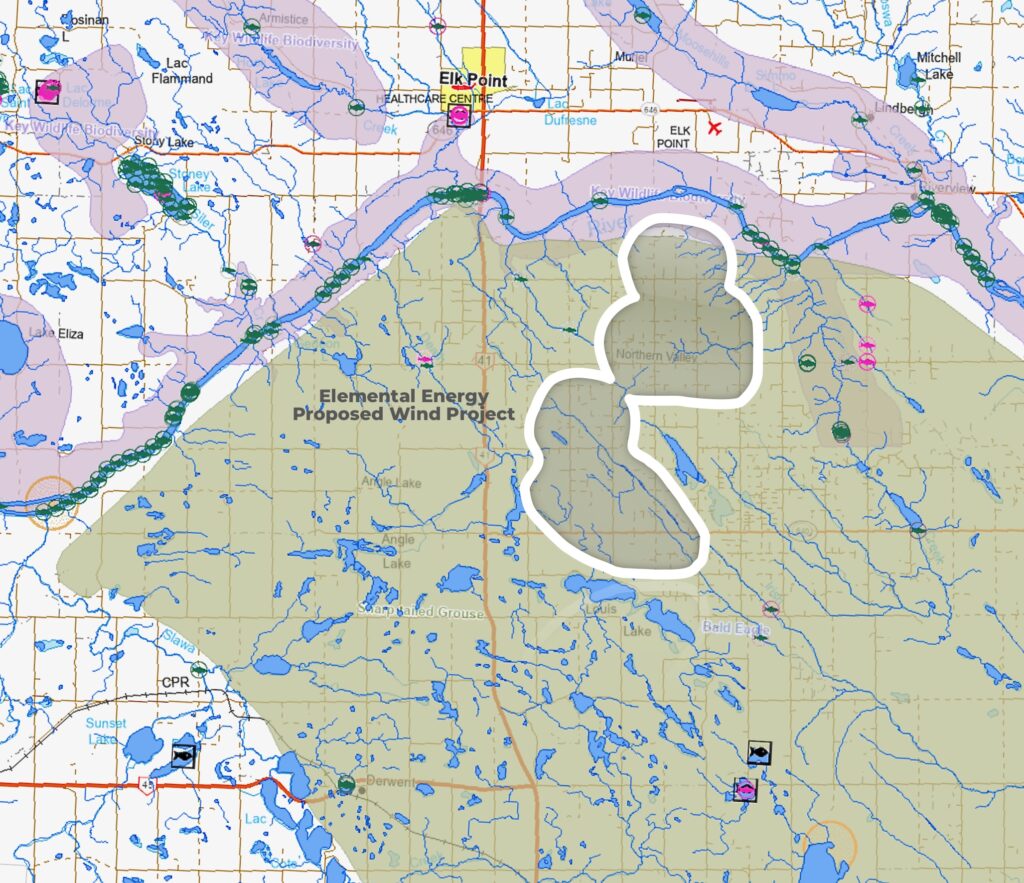
“It’s potentially a game-changer for those of us in the Northern Valley,” near Elk Point, Alberta, says resident Mark Mallett, and Editor in Chief of Wind Concerns. “All the 17 proposed wind turbines for this region would be well within 1500m of people’s homes, and so these new rules would effectively kill this project — if the County adopts the setback.” Again, the AUC confirms that they intend “to accept and apply those setbacks in future facility application decisions in that municipality.”
Not that municipalities have needed this change from the AUC to amend their bylaws. Kneehill County and the MD of Provost have already implemented new bylaws in 2024 requiring wind turbines to be set back 1.6km from dwellings.
On May 12, 2026, the County of St. Paul, in which the Northern Valley resides, acknowledged the AUC’s new directives on setbacks in their Council meeting.2 According to County Reeve Glen Ockerman, in a phone call to Wind Concerns later that evening, a motion will be put forth on May 26, 2026 to adopt the 1500m setback and initiate an ammendment process. Only a week before, the Council had stunned residents by turning down an amendment to implement a setback to protect them from Big Wind. But it seems the AUC’s own directive has turned the tide.
It’s the first time residents there are seeing light at the end of a long, dark road. “It’s been three years since this community began fighting against the incredible imposition this wind project would be on our community, property values, aesthetic beauty, health, and livestock,” says Mallett. “The anxiety levels really haven’t left us since, until now, the AUC has pretty much rubber-stamped every wind project application.” Mallett, who has met several times with the Ministry of Affordability and Utilities, credits Minister Nathan Neudorf for having listened to rural concerns and the need for setbacks.
“We just hope this protects in some way all those rural Albertans who have had their lives turned upside down when they learned their quiet communities could be rezoned for such destructive and ultimately unreliable energy sources. However, I fear it will still leave many families exposed…”
A Glaring Ommission – Infrasound
Indeed, there is one glaring omission, says Mallett, and that is the AUC’s proposed standardization of setbacks decidedly does not account for the impacts of infrasound. That’s the inaudible sound pressure waves generated each time the blades pass the base of a wind turbine.3 These waves can travel well over 20km4 and have been clearly documented to cause harm to human and animal health alike.
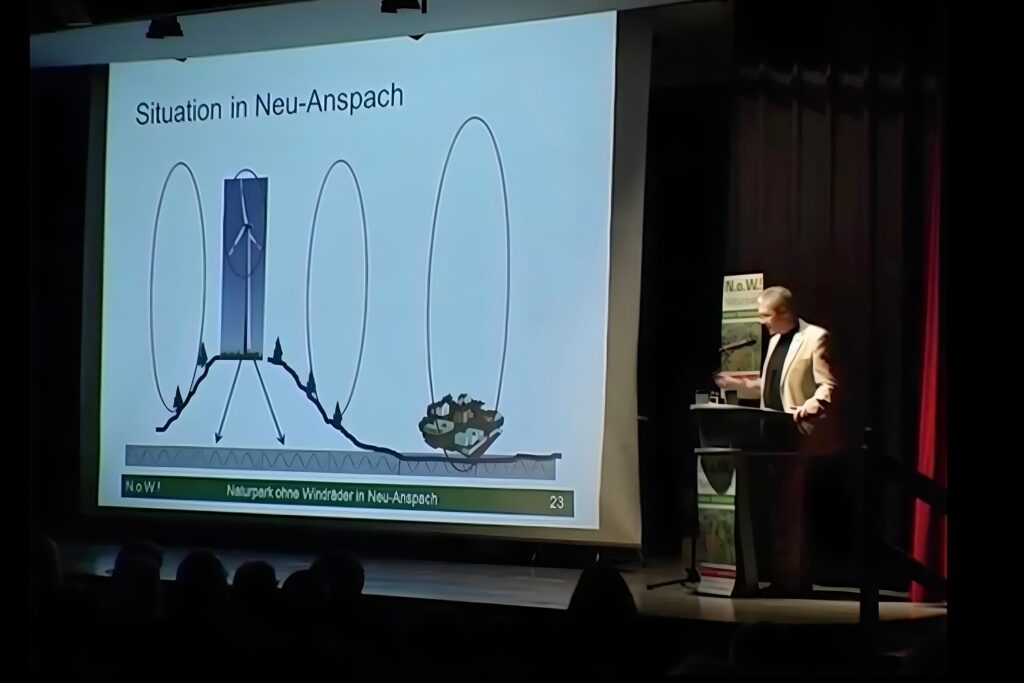
“During the AUC’s municipal consultation on these proposed setbacks, we and others raised this question — but the AUC panel not only avoided reading our question out loud, but dismissed the concern as somehow settled science. But that’s like saying smoking is harmless in 2026.” The science is, in fact, more damning by the day, says Mallett.
In a submission to the AUC’s consultation process on setbacks, Wind Concerns stated among other things:
As was publicly noted in the Oyen decision, Rule 12 does not measure for infrasound. According to the World Health Organization, “a large proportion of low frequency components in a noise may increase considerably the adverse effects on health.” In 2018, the WHO updated its noise guidelines noting “stronger evidence of the cardiovascular and metabolic effects of environmental noise; inclusion of new noise sources, namely wind turbine noise…” that it includes as “one of the top environmental hazards to both physical and mental health and well-being.” …Based on his peer-reviewed studies, Prof. Ken Mattson, PhD, concluded, “Infrasound can potentially spread at least 10 kilometers at levels that have proven to affect people. So I would say safe distance is most likely five to ten kilometers at least.” (Copenhagen, October 8, 2025) …Thus, a setback of 800 – 1500m simply does not protect rural residents from infrasound, symptoms which scientists say can take as long as 2-3 years to manifest for some individuals. Dastan et al. (2026) state that: “Infrasound can travel long distances with minimal attenuation and permeate biological tissues due to its marked particle displacement and deep penetration” (“Infrasound and Human Health: Mechanisms, Effects, and Applications”, February 2nd, 2026).
Restoring Rural Order
Still, the Alberta Government has placed new stipulations on renewable energy that have significantly reduced the “free-for-all” market conditions that existed before:
• A 35km buffer zone was implemented in front of key mountain ranges;
• Energy proponents will now be required to pay for new transmission lines;5
• Developers will be responsible for reclamation costs via bond or security;
• Alberta will no longer permit renewable generation developments on Class 1 and 2 lands, as classified by the Alberta Land Suitability Rating System (LSRS), “unless the proponent can demonstrate the ability for both crops and/or livestock to coexist with the renewable generation project”;
• and municipalities have now been guaranteed a seat at the table during the approval process and will be eligible to request cost recovery for participation from proponents. (Source: bennettjones.com)
While climate change “think tanks” are, of course, complaining since this is a spoke in the wheel of their wealth redistribution scheme (ie. “communism with a green hat“), rural Albertans are not. The rapid deceleration of unreliable, costly, disruptive, and ultimately ugly renewable industrial installations is a welcome beginning to restoring a semblance of order in the province’s countryside. Standardized setbacks are just one more tool to protect the province against aggressive energy corporations, all too willing to trample on rural Albertans.
- cf. The Western Producer, December 22, 2022[↩]
- Watch the proceeding here[↩]
- cf. Wind Infrasound Validated[↩]
- cf. Wind Turbine Sickness: How Far is Safe?[↩]
- cf. narhwal.ca[↩]


Wind Concerns is a collaboration of citizens of the Lakeland Alberta region against proposed wind turbine projects.