

In a stunning decision, the County of St. Paul Council voted not to amend its bylaw in order to enact crucial protections for rural residents from industrial wind turbines. Three councilors voted in favor, four against.
Why the Amendment
Over 50 families in the Northern Valley south of Elk Point, Alberta, represented by Wind Concerns, requested that the current bylaw regarding setbacks of turbines from human dwellings be amended. The request is based on a growing mountain of peer-reviewed evidence,1 testimonies,2 and court cases3 showing that industrial wind turbines can seriously impact human and animal health.4 Scientists and researchers around the globe are calling for setbacks of 5 – 10kms from human dwellings, schools, businesses, etc. due to ““significant biological impacts”5 that include a host of health problems such as insomnia, headaches, depression, high blood pressure, dizziness, tinnitus, heart problems6 and damage to cells in the brain.7

The main culprit is infrasound. It is an inaudible sound “pressure” that is generated each time a blade passes the turbine tower, and can travel for over 20km. Infrasound can pass through walls and biological tissues, making it virtually inescapable. The World Health Organization (WHO) in its 2000 publication8 said, “It should be noted that a large proportion of low frequency components in a noise may increase considerably the adverse effects on health.”9 Then in 2018, the WHO updated its noise guidelines noting “stronger evidence of the cardiovascular and metabolic effects of environmental noise; inclusion of new noise sources, namely wind turbine noise…” that it includes as “one of the top environmental hazards to both physical and mental health and well-being.”10
Real-Life Impacts – and Consequences
It’s not hypothetical. In Ontario, thousands of residents reported health ailments after massive turbines were built around their homes. After several years, Wind Concerns has learned that many residents have not been able to return home — their farmhouses or acreages sitting empty and unsaleable (see Ontarians’ Turbine Nightmare Continues). In fact, an Ontario Tribunal concluded:
…the debate should not be simplified to one about whether wind turbines can cause harm to humans. The evidence presented to the Tribunal demonstrates that they can, if facilities are placed too close to residents. The debate has now evolved to one of degree. The question that should be asked is: What protections, such as permissible noise levels or setback distances, are appropriate to protect human health?
Environmental Review Tribunal, Case Nos.: 10-121/10-122 Erickson v. Director, Ministry of the Environment, July 18, 2011, p. 207

In 2019, Ontario Premier Doug Ford canceled some 750 wind projects11 while the Tribunal’s conclusions have been essentially ignored from a victim’s perspective.
In Europe, however, the courts have not only recognized the evidence, but ruled in favor of plaintiffs for damages caused by industrial wind turbine “noise” and other impacts. This includes Australia’s Supreme Court,12 and a French Court of Appeal that recognized “the typical symptoms: headache, painful pressure on the ears, dizziness, weakness, tachycardia, tinnitus, nausea, nosebleeds and insomnia”, which was “traced back to low-frequency noise and infrasound.” It awarded the plaintiff’s claim for damages of €128,000.13 Norway’s Supreme Court awarded herdsmen 90 million NOK (10 million USD) in 2021 for wind farms that interfered with their livelihoods due, again, to wind turbine “noise.”14 The Irish Supreme Court overturned approval for a Cork windfarm after finding the board erred in failing to consider submissions from a local couple concerning developing knowledge about noise impact from turbines.15 In a later decision (2024), the High Court ruled that those impacted by turbine “noise” are now entitled to damages.16 Finally, in the equivalent of the Supreme Court in France, it made a historic ruling in March 2024 against granting permits for onshore wind ‘to protect the health of local residents.17
The AUC… Not Following the Science
The real-life evidence above is precisely why Northern Valley residents have asked that their County amend its bylaws as a preventative measure against the ever-taller turbines of Big Wind. Indeed, in their peer-reviewed study of four decades of research, Punch et. James concluded:
…the short siting distances used by the industry for physical safety do not protect against Adverse Health Effects… A pro-health view holds that the precautionary principle must be followed in siting IWTs [industrial wind turbines] if health risks are to be avoided, and that it is unacceptable to consider people living near wind turbines as collateral damage. Industrial-scale wind turbines should not be located near people’s homes, educational and recreational facilities, and workplaces.
“Wind Turbine Noise and Human Health: A Four-Decade History of Evidence that Wind Turbines Pose Risks”, Dr. Jerry Punch and Richard R. James, October 21, 2016
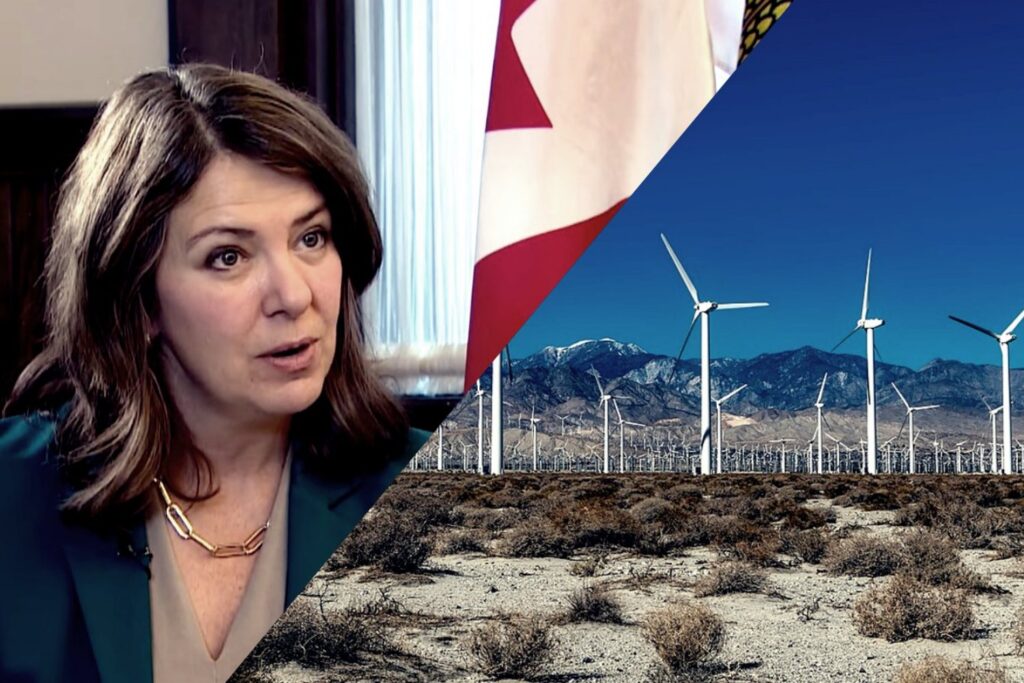
Rural residents across the province had felt, at least initially, that the province was starting to grasp the situation (and we haven’t even addressed the fact that numerous studies by realtors across North America have found properties near industrial wind turbines to drop in value by as much as 40%).18 After the provincial government and the Alberta Utilities Commission (AUC) invoked a 6-month “pause” on renewable energy approvals in 2023, Premier Smith appeared before the cameras declaring:
Albertans have been vocal that they don’t want large-scale developments to interfere with our province’s most beautiful natural features. You cannot build wind turbines the size of the Calgary tower in front of a UNESCO World Heritage site; or on Nose Hill; or in your neighbor’s backyard. We have a duty to protect the natural beauty and communities of our province.” She added: “…growing our renewable energy industry must happen in well-defined and responsible ways. That wasn’t happening… We need to ensure that we’re not sacrificing our future agricultural yields, or tourism dollars, or breath-taking viewscapes to rush renewable’s developments through.”
Premier Danielle Smith, Press Conference, February 28, 2024; YouTube
However, aside from a buffer zone preventing turbines from being built within 35km of the mountains, nothing has been done to prevent turbines from being built “in your neighbor’s backyard.” What is most disturbing is that the impacts of infrasound are not even being accounted for by the province’s regulatory body. In a recent hearing for a wind project near Oyen, Alberta, German doctor and expert on the impacts of infrasound,19 Dr. Ursula Bellut-Stack, noted this glaring omission:
Rule 0012 [of the AUC’s regulations] does not deal with infrasound but “is only dealing with the audible part, therefore not dealing with the infrasound part, and the infrasound effects… What is not being considered is infrasound as a physical energy, and the scientific findings that relate to that, that should also be considered now.”
Dr. Ursula Bellut-Staeck, AUC Hearing #29377 on Oyen wind project, YouTube at 52:21
However, the Commission outright dismissed her expert witness, which has since been confirmed in recent peer-reviewed studies and research by Dr. Håkan Enbom, M.D., Ph.D., Prof. Ken Mattsson, Ph.D., Chaban et. al., and Dastan, Lehmann et. al. etc. The reason, the AUC stated in their Oyen decision, was due to a study by Health Canada, which has been widely panned by audiologists and infrasound experts alike.
The Commission accepts that the Health Canada Study was based on extensive and comprehensive measurements, modelling and surveys… the Commission finds that the [Oyen Wind Albert, Inc.] project is unlikely to have adverse noise impacts to residents.
AUC Decision 29377-D01-2025, October 20, 2025
“However,” say Dastan et. al. in their peer-reviewed study in Applied Sciences, “those studies do not consider the current state of knowledge regarding the impact of infrasound on cellular mechanotransduction, as reflected in blood pressure and heart rate measurements.”20 Nor does the AUC or Health Canada study even use proper measurement methods for infrasound, as we noted in several articles here (see “New Peer-Reviewed Study: Infrasound Causes “significant biological impacts” and “We’re Measuring the Wrong Thing”).
As such, Northern Valley residents — after being required to pay a $1000 fee to the County of St. Paul — requested that a 10km setback be incorporated into the current bylaws. Presently, a project proposed by Vancouver-based Elemental Energy of 17 turbines towering over 200 meters high, slated for construction in 2027, would erect turbines as close as 700m to people’s homes.
Council Denies — Voters Betrayed
In a resolution passed at the United Conservative Party’s November 9th, 2022 convention, it noted that the AUC’s approval process for renewable energy projects on private land “has little to no regard for the rural municipalities’ statutory plans, or requirement for consultation with the municipalities.”21 It has been left to rural residents to defend themselves against Big Wind and a self-governing regulatory body that is ignoring peer-reviewed science.
The current bylaw in the County of St. Paul reads:
(29) The setback distance between a WECS and a dwelling, within and without the project boundary, shall be as established by the Alberta Utilities Commission through the calculations of AUC Rule 12.
Section 7.35; see “Land Use Bylaw, St. Paul No. 19”
Since Rule 12 does not even measure infrasound, Northern Valley residents asked the bylaw to be amended to read:
A WECS shall be located a minimum distance of 10 km (6.21 miles) from any dwelling not belonging to the owner of the land on which the WECS is located or at the distance established by the ‘AUC Rule 12: Noise Control’, whichever is greater.

“We asked for an aggressive 10km setback,” says Wind Concerns’ Levina Ewasiuk, an award-winning nurse, “for basically two reasons: the science is overwhelmingly clear that wind turbines are causing harm. The second is that wind corporations are now building offshore-sized turbines22 next to people’s homes. Neither the AUC nor the wind corporations have accounted for what will be a veritable experiment on humans and livestock, who cannot escape harmful infrasound.”
Once again, this isn’t theory but the lived experience of people all around the world. Wind Concerns received this comment recently from a reader in Scotland:
I live in SW Scotland and have been suffering the ill effects from wind turbines for the last 16 years. It started with waking from nightmares to the reality of the physical force of the regular thump of the turbines. Dizziness when I got up to walk about. As the numbers of turbines and wind farms increased, my property was surrounded by 200 turbines within a 4 km range and latterly by several outer rings, the vibrations of which have been measured by equipment installed in my house for that purpose.
The effect of these and their increasing size has had a devastating effect on my quality of life. Additional problems have developed, excrutiating pains in my ears which move from ear to ear when I turn through 180 degrees, sickness and diarrhorea. When I leave home for a while everything becomes normal again…

For two years, the County of St. Paul’s Council has been briefed both formally and in written letters by Wind Concerns as to the current science and testimonies, such as you just read.
“Many of us feel disappointed and betrayed, especially when the AUC has directly stated that it will take into consideration the land use bylaws of municipalities,” said Chris Habiak, who has been fighting against wind corporations in this region for over 9 years. Indeed, in the AUC’s decision on the Foothills Solar project, which was denied, they stated:
The Commission and its predecessors have consistently held that it must have regard for a municipality’s land use authority and planning instruments when deciding if approval of a project is in the public interest…
Section 3.2.1
Habiak points out that two other Alberta municipalities have already implemented setbacks of 1.6km from dwellings, namely Kneehill County and MD Provost. “Why St. Paul’s Council could not even copy and paste the bylaws of other counties at a bare minimum, is beyond us,” he said. “The voters here want answers, and we expect them.”
We reached out to the County Reeve, Glen Ockerman, last night and to the six councilors today with several questions about their reasoning to deny the amendment, but did not receive a response by press time.
To make your views known to the County of St. Paul Council, you can contact them here.
- eg. here and here[↩]
- “Ontarians’ Turbine Nightmare Continues”[↩]
- see cases here[↩]
- “Wind Turbines and Health: The Studies”[↩]
- “Experts Call for Serious Setbacks to Protect Humans”; Study: “Infrasound and Human Health: Mechanisms, Effects, and Applications”, February 2nd, 2026, mdpi.com[↩]
- “German Engineer: Stay 5km Away from Wind Turbines”, “Turbine Sickness: How Far Away is Safe?“, “Wind Turbines and Infrasound: the Risks the Authorities Choose to Ignore” (World Health Council) [↩]
- “Infrasound Affects the Brain”[↩]
- “Community Noise” by Berglund et. al.[↩]
- WHO cited in “Adverse Health Effects of Wind Turbines”, Keith Stelling, MA, MNIMH, Dip Phyt, MCPP (England), with additional files from Carmen Krogh, BScPharm; October 20, 2009; pp. 18-19[↩]
- “New WHO noise guidelines for Europe released”, October 10, 2018; www.who.int[↩]
- cf. financialpost.com[↩]
- cf. here[↩]
- cf. connexionfrance.com[↩]
- cf. An Assault on Lakeland Animals and Wildlife [↩]
- December 12, 2019; irishexaminer.com[↩]
- cf. Ireland: Landmark Wind Turbine Noise Ruling[↩]
- cf. France: Historic Decision Halts Wind Development[↩]
- cf. here and here[↩]
- cf. “New Peer-Reviewed Study: Infrasound Causes “significant biological impacts”[↩]
- “Infrasound and Human Health: Mechanisms, Effects, and Applications”, February 2nd, 2026, mdpi.com[↩]
- Red Deer Advocate[↩]
- see here and here[↩]


Mark Mallett is a former award-winning reporter with CTV Edmonton and an independent researcher and author. His family homesteaded between Vermilion and Cold Lake, Alberta, and now resides in the Lakeland region. Mark is Editor in Chief of Wind Concerns.