

A presentation by Dr. Håkan Enbom, M.D., Ph.D., Copenhagen 2025
Highlights:
• Infrasound cannot be heard but is penetrating. It doesn’t meet any obstacles; it goes straight through the walls here, it goes straight through our bodies. It goes through the skull.
• 120 decibel and 140 decibels. These are levels where you can start talking about damage to cells in the brain, levels that also arise from wind turbines.
• Infrasound can cause other effects without damage: irritation, stress, significant function impact without damage.
• It’s a pulsating quality in the infrasound from wind turbines that is what is so-called “annoying” and what creates discomfort in many people.
• If you live near a wind turbine, one of the first things you notice is that your sleep is disturbed. Then you experience an increase in sensory discomfort. You become more sensitive to sound and light and more prone to motion sickness. You find it unpleasant to drive to work because of the rumbling. It can trigger various forms of dizziness.
• This increases the risk of vascular effects. This tendency toward constricted blood vessels increases the long-term risk of both heart attack and stroke.
• You can choose whether you want to listen to your cell phone. You can choose whether you want to sit in air conditioning that hums or a light that flashes. But if you live near a wind turbine, you can’t choose whether or not you want to be exposed to this influence. It’s a factor that’s very difficult to avoid and can be dangerous in the long term.
• Infrasound. You can’t escape it. It’s constantly there like a carpet. And how big is that carpet, really? Is it just around the wind farms? Or is it a carpet that you could say spreads across the whole of Europe? More or less.
• Infrasound affects the sensory cells in the ear. It can also pass through the skull and affect the slow brain waves and the risk of getting migraines. It’s a product of intensity and exposure, so those who are very sensitive will experience problems very quickly, while those who are less sensitive may take a year, but then they may experience a period of depression or anxiety. Even though infrasound is the cause, it is difficult to prove.
• The risk of heart attack and stroke, the risk of premature aging and ischemia… how can you know that it’s the infrasound? Infrasound travels far, but you can’t hear it, so how can I know that it’s that? So it’s very difficult for those affected to relate it specifically to infrasound. It’s hidden.
Transcript
(Note: translated through AI and so inaccuracies may result)
High Sensitivity Persons, HSP. Approximately 30% of a population, and that’s quite a lot, a third of Denmark’s or Sweden’s population, belongs to the group that is a little more sensitive than the other part of the population. So it’s not a small part that we’re talking about.
And when we describe these people who are a little more sensitive than others, it’s people who have special characteristics. They’re skilled people, they’re driven people, they’re ambitious people who like order and order, careful people. And they’re also more sensitive.
They have a nervous system that is faster and better functioning than other people’s nervous systems. And that means that they’re also more light-sensitive, more sound-sensitive. Often they’re more deaf-sensitive.
Actually, all mental organs are a little more on the toes with these people. We’re talking about infrasound, and I want to briefly present infrasound. It’s a sound that you can’t hear, right? But it’s also a sound that’s very penetrating.
It doesn’t meet any obstacles. With the walls here, it goes straight through the walls here, and it goes straight through our bodies. It goes through the skull.
Strange, isn’t it? And it has a long spread. It spreads far and wide. Enough about that.
How He Got Hooked Onto Infrasound
Who am I, then? Otoneurologist.1 It’s a special type of education where you start as an ear doctor, and then you add an education in neurology. I’ve worked for several years in a neurophysiological laboratory before I got this specialization.
I’ve also done research for several years in Lund, Örebro and Helsingfors, among others. I wrote a paper about 30 years ago about how all our sensory organs and brain work together to control the balance, the postural control. It’s strange that we humans can stand on two legs, right? We could walk like all other animals on four, but we have a very good postural control, and that’s the function I studied a long time ago.
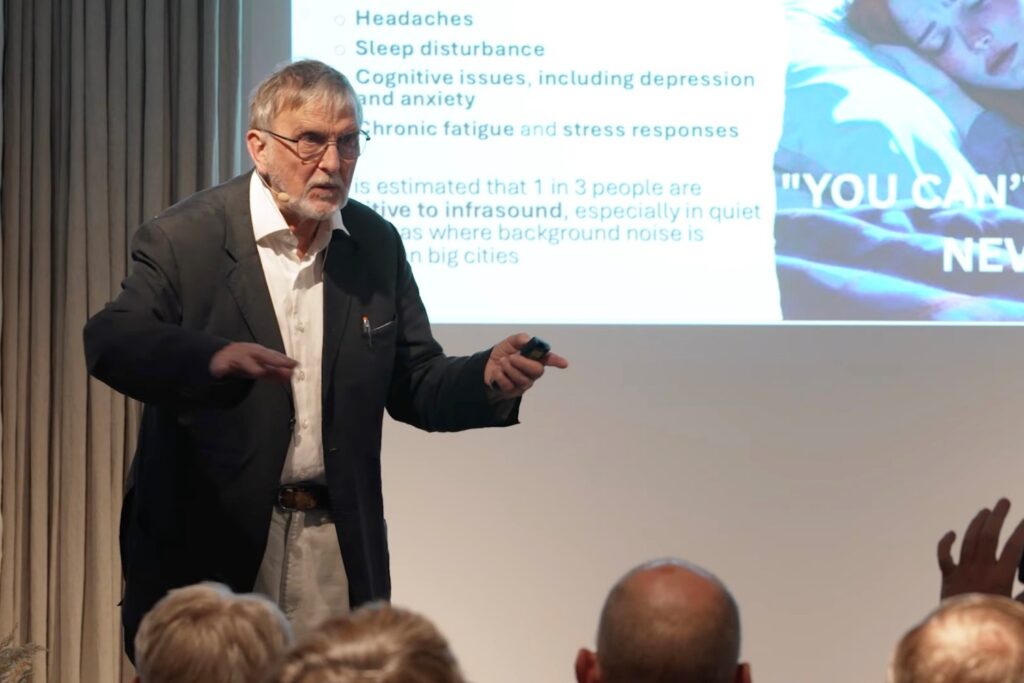
History. What does an otoneurologist do, which is different from a neurologist? I work with the nervous system that sits in the topmost part of the spine, what’s called the brainstem, what’s under the brain. From that area, the 12 brain nerves are connected to the face.
These are the nerves that control hearing, balance, sight, smell, taste, but also swallowing function, feeling in the oral cavity, feeling in the face. All the nerves in this area are my area as an otoneurolog. My workroom is a laboratory at a regional hospital or university hospital, where we examine and study the functions of these different nerves.
But why am I here today? I don’t really deal with infrasound. It’s a long story, but about 20 years ago, maybe 15, I was going to try a new technique to treat tinnitus in people who were hearing-sensitive, HSB, High Sensitive Persons. Tinnitus is usually caused by hearing loss.
Hearing loss causes tinnitus, so you tend to get used to it after a year or two, or put it in the background and forget about it. But this group with HSB have a more sensitive nervous system and find it difficult to get used to a tinnitus tone. They can also get tinnitus without hearing loss.
That’s what makes this group different. I’m going to try to try a new form of treatment. The natural treatment for common tinnitus is that you wait and see if they don’t get used to it after a year or so.
If you think it’s too difficult with tinnitus, you try to reduce the activity of the nerves in some way, like medication for anxiety or depression or medicine for epilepsy. These have the ability to reduce the activity of the nervous system. It’s not a fun medicine to take, especially if it’s children who have tinnitus.
Many children can get tinnitus. It’s not fun to give side effects to children with medicine. These highly sensitive people are not only sensitive to light and sound, they are also sensitive to medicine.
It’s a dilemma, because then they get easier side effects. I wanted to start this new technique in a place that was quiet and without disturbance. At the university, there was a lot of traffic, noise and other things.
We had a place in the countryside, a bit outside of Lund, where we thought we would have this method. But it turned out that just 500-800 meters from that place, we were going to build a wind power plant. That didn’t really work out.
That’s where it started. I had to think about whether we should stay here or move. I read about it in the literature and realized that we didn’t manage to stay here, so we had to move.
But anyway, the articles that existed at the time were not very many. The articles that were written were mostly written because people thought they saw a connection, but without a good scientific basis. It started with Nina Pierpoint, and later we have Jeffrey’s article, with several articles that showed that many people around the wind power plant got sick in some way.
But there were many other articles, where they examined the effect of wind power and couldn’t find any damage or impact, even though the studies that Professor Mattsson said perhaps didn’t have such high quality. Anyway, I wrote an article in Läkartidningen 2013 and wrote that this group of highly sensitive people is a risk group. Even though other people suffer from inflammation from the wind power plant, in the studies that are done, there is still a group of people, perhaps 30% of the population, who have increased sensitivity, and we should take note of that.
But we didn’t. We neglected this article, and I forgot about it and did something else. Until a few years ago, when Professor Mattsson contacted me, he had read the article and thought that we might be able to take it up.
Now the old rusty horses are getting in the way again. I’ve been going through the literature over the past year, and you can find a lot of gold coins. If you look at the yellow markings, you can see that in the last ten years there have been a lot of new articles about the influence of infrared light on humans.
The Brain and Nervous System
That’s what I’m going to summarize and present today. To make it exciting, I’m going to start by teaching you about the nervous system. Welcome! The nervous system is driven by the brain cells of the body.
If we didn’t have brain cells, everything would be black and empty. We wouldn’t function. Zero.
Nothing. So basically, all of our brain cells, vision, hearing, balance, feeling, proprioception, everything, is a motor for us to live. A motor for the nervous system.
All of the information from our brain cells goes up through the spinal cord, up to the brainstem, and further up to the brain. In the brain, the information is processed. We think, we create our imaginations, our memories.
From that information, a reaction occurs, in the form of a movement, or speech, an activity. We’re talking about a new area in the brainstem, which I usually call the reptile brain. I say reptile brain because it’s actually the most original part of the nervous system.
Even the dinosaurs, many, many, many hundreds of thousands of years ago, had a reptile brain. There are many vital basic functions here. Breathing function, blood pressure regulation, an awareness center, formatio reticularis, which is incredibly important for our degree of activity, appetite, sexuality, and many basic reflexes.
Reflexes that allow us to stand, reflexes that allow us to walk, neck reflexes, eye reflexes, reflexes that allow us to look sideways and at the same time fix our gaze on an object, like the hunter who hunts a wild boar. In this area, we have the big brain. In the big brain, there’s another area called the emotional brain, or the limbic brain, the limbic system.
This is the area where we form our emotions. Lust, anger, anxiety, discomfort, love, joy. It’s an emotional center, you could say.
The Impacts of Infrasound
And a part of this center, the little mosquito net down here, is an area that is particularly affected by infrasound, if you can call it that. And this area is an area where you experience anxiety or fear or discomfort if you activate this area. Infrasound, as I said earlier, is a sound that humans can’t hear, so it doesn’t matter.
But even if you can’t hear it, the infrasound […] comes into the brain and activates different centers, such as the amygdala. And they can either come in through the skull bone directly, these slow waves, and affect the brain’s own waves. You may know that in EEG, you put an electrode on the skull bone and measure the brain’s waves.

These are the ones that are emanated from the upper part of the cerebellum, the cortex. But these waves in their turn are controlled by brain waves that are generated from the cerebellum and the medial brain, especially the thalamus. And these waves are much, much slower.
And they are similar in their frequency, these infrasounds. And here there is a possibility that they can interfere with each other. The only way that infrasound can affect is through sensory cells in the inner ear.
Not the normal cells, but the ones that belong to the other cells in the auditory organ can be affected. And they can activate the amygdala, above all. A very recent study, from this year, has studied the damage effects of infrasound on test animals, not on humans.
And we see there, 120 decibel and 140 decibel. These are levels where you can start talking about damage to cells in the brain. And these are actually levels that also arise from wind turbines, but significantly closer.
And the question is, what is the limit there? And that is the limit that one should try to find when building wind turbines. On the other hand, infrasound can cause other effects without damage. I mean, you can get irritated, you can get stressed, and that is a significant function impact without being damaged.
And then you have increased activity in the brain as a result of a very increased input of sensory activity. The first thing you notice is sleep disturbance. You get it from increased activity in the brain in the formatio reticularis.
Symptoms from Infrasound
And that sleep disturbance is usually caused by sleeping a lot more, so that you wake up from almost nothing and have a hard time falling asleep. The impact on the transmitter system, depression and anxiety, are among the disorders that quickly occur if you are exposed to infrasound. And the extension of amygdala, which I talked about earlier, creates anxiety.
So anxiety is something that is easily affected if you are exposed to infrasound. And a fluctuating infrasound is a very strong trigger for migraine. And do you know what this picture was? It’s actually quite a pleasant light, but when it’s pulsating like this, it creates a quality that is very unpleasant.
And it’s this pulsating quality in the infrasound from wind turbines that is what is so-called annoying and what creates discomfort in many people. As I said, everyone can be affected by infrasound. It’s not like that.
Is the infrasound high enough? It’s dangerous. But it’s especially this group of highly sensitive people who are in the “risk group” to get discomfort. And the discomfort that usually appears first is what is called annoyance, i.e. irritation, sleep disturbance, i.e. insomnia, anxiety, depression and the risk of developing headaches.
Migraine. And, as we’ll come to later, migraine-related diseases.
Those With Increased Sensitivity
About 30% of the population is born with an increased sensitivity.
It’s genetic. It’s these people who have an increased sensory sensitivity that can be affected by migraine. But not everyone is affected by migraine.

Many who have this genetic disposition with sensory sensitivity and so on, they spend their whole lives without ever getting migraine headaches. But if they had ended up in an extreme situation, for example, sudden nausea, migraine, and exhausting mental conditions, then they could get eye migraine or migraine headaches. As a result of this suddenly increased sensory tension.
So you are born with an extra-sensitive nervous system. And you are born with extra-sensitive brain cells. The motor to the nervous system is more sensitive.
And this increased sensitivity affects all brain cells. It’s not just vision and hearing. It’s also feelings.
It’s also proprioception. That is, the sensors in all body muscles that recognize how we stand and walk. It’s sensory cells for pain, cold and heat.
Chemical receptors. Yes. Everyone has an increased sensitivity.
And this means, of course, that relatively less rectification creates a signal compared to a normal person who does not have this nervous system. So it means that a person who has an increased sensory sensitivity will always have a certain increased flow in the nervous system from all sensory organs up to the brain stem. So the brain stem and brain will always be exposed to increased pressure, one might say, from nerve signals.
And as I said, only a quarter of the population has an increased sensitivity. But this is also a bit relative. Because not everyone has the same degree of increased sensitivity.
The vast majority have a moderate degree of increased sensitivity and perhaps do not think so much about it. And another part has a lower degree of sensitivity, while around 13 to 15 percent have a really high sensitivity. And this means that this group of people who come to a wind turbine may be affected by symptoms already after a couple of hours of exposure.
This group may not get any discomfort until it has been a week, or a month, or a year. This group may not get discomfort until it has been exposed to this treatment for a year, or two, or three. So the degree of sensitivity varies in the population.
And that means that everyone who has an increased sensory sensitivity is not the same. We are not the same as humans, really. There is a difference.
Three Factors of Impact
So to be affected by discomfort from the infrasound, it depends on three factors. First, on the degree of sensitivity, how you are as a human being. Second, on how loud the sound is, how far you are from it, and the exposure time.
These three factors must be taken into account if you want to assess the degree of danger of the infrasound. Back to the brainstem. We talked about a center called the formative reticular that controls the awareness.
If you affect the brainstem, the first thing you get discomfort from is an increased alertness, an increased brain activity, and an effect on sleep, because you will be lying in a state of deep sleep. You also get an effect on the centers of the brainstem, especially noradrenaline and serotonin. An increased activity in this system with noradrenaline, you know that adrenaline makes you more stressed if you increase your adrenaline exhaustion.
An increased activity means that you have a higher stress level if you have been exposed to too much sensory influence in the brainstem. Serotonin is a bit complex. You might think that an increase in serotonin would make people a bit calmer, but it is a complex reaction where the interbrain and the thalamus are involved, which results in the opposite effect.
You get an increased anxiety and an increased risk of depression. Right here in the brainstem, this increased influence and the effect on the signals also affects the personality. So those who are lucky enough to be born with a really nice and sensitive nervous system, HSP, high-sensitivity person, they have the good fortune to get a different, special personality.
And that personality is a good personality. There are often very famous people in history who have high-sensitivity or migraine. Often very active and driven people who stand out in history.
And what makes these people so special is that they are often very active, they do things, they are energetic, and very well-structured. They like order and order. There shouldn’t be a mess in the drawers and papers here and there.
It should be order and order. Control needs. Easy to learn.
There are those who have what you call a photographic memory in this group. They just need to look at a page and they learn. Very interesting.
Empathetic. They worry a lot. They often come to the reception and are concerned about small things.
And sleep problems. These people we are talking about, HSP, they have a higher influx of nerve signals from the body’s all nervous cells from the beginning of birth. But then there are factors that add to the nervous system, which we call trigger factors.
They increase the nervous activity even more. And it’s stress in different forms. And they are usually distinguished between emotional stress, we’re talking about a worn-out divorce, or the boss who gets angry and says how are you going to finish tomorrow because you are so dull? Or sensory stress.
And sensory stress, it was this picture before, where the light flickers or a lot of noise, children screaming in a classroom and throwing chewing gum. Flickering light and fluctuating sound. They are especially sharp triggers.
And you get an increased influx of a trigger. And you are already at a high level of activity in the nervous system. Somewhere there is a threshold.
And if you go over that threshold, that’s when you get headaches. Migraine. They say that migraine starts with what you call an aura.
Impacts on the Brain
And that’s when you’ve gone over that threshold. And there is far too much nervous activity up to the brain. Then it starts as an infection of nervous activity somewhere in the brain.
And usually it’s in the back of the brain where the center of vision is. Because it’s closest to the brainstem, you could say, locally. And that infection is perceived by those with migraine as if something is happening with their vision. They may see zigzag lines or a band of color moving in their field of vision, or they may see a blurry spot. It’s like trying to wipe the spot off your glasses, but it remains. This is because the increased activity constricts the blood vessels in that area of the brain. That part of the brain gets too little oxygen, too little blood supply. And that is what triggers the symptoms. And that is not good. It is not good at all.
This deteriorating situation then immediately triggers a series of reactions in the brain that lead to migraine headaches. And I will not go into detail because it is far too complicated. But in a nutshell, this constriction of the blood vessels triggers a secretion from the nerves around the blood vessels. They secrete a substance called GCRP, which causes the blood vessels to dilate again.

So this constriction is counteracted almost immediately by the blood vessels dilating again. This dilation itself becomes a little too powerful, and when the blood vessels dilate too much, they leak a little blood fluid, and it is the leakage of blood fluid around the vessels that will irritate the nerves around the blood vessels and make you even more sensitive. If you are sensitive to sound to begin with, you will become even more sensitive to sound and light from the outset; you become even more sensitive to light during this period.
I usually say that it’s similar to sunbathing a lot. If you lie on the beach for a day and sunbathe your back, your back will turn completely red. And it’s not a sunburn, it’s because the blood vessels under the skin are dilating as much as possible to protect against the ultraviolet rays. But when they constrict so much, blood fluid leaks out, and you can even get blisters on your skin from the fluid. But even without blisters, there is an increased amount of fluid around the blood vessels and your back. And it becomes very sensitive. So when you try to lie down in the evening, it’s like lying on a thousand needles.
It is roughly the same thing that happens when the blood vessels in the brain dilate during a migraine. This dilation then subsides again naturally when the migraine attack has passed. But that is the process.
At the same time as this dilation of the blood vessels and exhalation, there is an activation back to the brain stem and up to the brain. So every time you have a migraine attack, you get increased activation of the brain. This causes what is known as increased arousal. Increased arousal is actually one of the characteristics of a person with migraine. You could say that you have a higher level of activity in the brain.
Brain Symptoms from Infrasound
Now let’s look a little at the symptoms and associated problems. It starts when the blood vessels constrict. This creates the various visual phenomena we talked about earlier. But there can also be completely different symptoms. There may be numbness in the face. You may lose feeling or strength in an arm. These are quite dramatic and unpleasant sensations. It can affect your hearing. Or cause unpleasant smells. You can have smell hallucinations. You can smell burnt rubber, for example. Suddenly, you wonder what on earth is going on. So you go to the doctor and say you smell burnt rubber. And they say, are you having hallucinations? What could be causing this? And not many people think that it could be related to migraine.
Unfortunately, this is an example of a woman in her 30s who comes in with sudden dizziness, vomiting, and nausea, and at the same time, there is a slight numbness in her cheek, and then you think, Oh my God, is this a stroke? So you do an emergency X-ray of the brain and an emergency X-ray of the blood vessels in that area to see if anything has happened. And then you see that they have a tachycardia, no stroke. But when you look at the vessels, you see… Aha!
Here’s good circulation. But those are the vessels that go to the cerebellum. What? This is what it actually looks like on the underside of the brain. That’s where the blood vessels go up and spread out. It’s this vessel here that supplies the cerebellum. Which is affected in its circulation. If you disrupt the circulation to the cerebellum, you get ischemia. Two days later, after the examination, the woman was almost immediately symptom-free after the X-ray examination and did not need to be admitted for treatment. But what did they find two days later? Well, you can see that the situation has started again. It was only temporary. It was a spasm in the vessel. And here you can see that something has happened in the cerebellum. But it is not a stroke. It is an increase in fluid. Swelling. It is similar to receiving a sharp blow if you swell up a little on the cheek after Nörrfield, for example. Which is temporary. Transient.
The woman is completely “symptom-free” and can go home.

The next step in this migraine phase is when the blood vessels relax and pulsating relaxed blood vessels cause headaches. Most often, it is a one-sided headache that is typical of what we have learned in textbooks as a migraine headache. The fact is that it depends on which part of the blood vessel network is subject to a spasm or poor circulation.
So the headache can be located in the forehead on both sides. It can be very common to have it only in the neck. It is not uncommon to have pain in the cheek, and it is exactly the same pain as bioinflammation. A lot of persistent pain is actually undiagnosed migraine attacks.
The third phase is the phase that causes more long-lasting problems and can be unpleasant. There are increased problems with sleep. If you live near a wind turbine, one of the first things you notice is that your sleep is disturbed. Then you experience an increase in sensory discomfort. You become more sensitive to sound and light and more prone to motion sickness. You find it unpleasant to drive to work because of the rumbling. It can trigger various forms of dizziness.
How you stand and walk. That is what creates this strange feeling. Brain fatigue. What is that? It is when you get inflammation around the blood vessels that affects a larger part of the brain. The first thing you notice is that you function less well. You get tired even if you sleep at night. So you are tired during the day. As you get older, in the long term, with increased problems with migraine headaches. Headaches and headaches. Poorly treated.
Impacts on the Vascular (blood vessels) System
This increases the risk of vascular effects. I said that people who have migraines tend to have blood vessels that are slightly constricted. You often have cold hands and cold feet. It is much more common in people with migraines, a condition known as Renault’s phenomenon. This tendency toward constricted blood vessels increases the long-term risk of both heart attack and stroke.
If you have been exposed to a lot of headaches in your life and even dizziness in old age, can be due to poor circulation and an increased risk of what is known as circulatory dementia. This is especially true if you are also exposed to other risk factors.
I am thinking in particular of smoking. What upsets me most today is glazed nicotine snus. This often contains very high levels of nicotine. This causes the blood vessels to constrict and impairs circulation. It also makes the blood vessels stiffer and stiffer over time. This leads to the generation of these women who have specifically started using white snus and who suffer from migraines. In 30 years, we will see an increase in the incidence of heart attacks and strokes in this group. They will age faster. I see this white snus as a disaster that will eventually affect society.
The Cruelty of Infrasound
Highly sensitive people are very talented people. They are driven people. They are people who really benefit society and whom society should take care of and protect. If these people suffer from various forms of sensory disturbance — I’m not just talking about infrasound — I’m talking about cell phones, TV screens, computers, sound systems, ventilation from air conditioning. The whole mess of sensory input that affects people with more sensitive nervous systems.

You can choose whether you want to listen to your cell phone. You can choose whether you want to sit in air conditioning that hums or a light that flashes. But if you live near a wind turbine, you can’t choose whether or not you want to be exposed to this influence. It’s a factor that’s very difficult to avoid and can be dangerous in the long term.
What can happen in the long term if you have an increased tendency to migraines and headaches upon headaches upon headaches upon headaches upon headaches upon headaches. Inflammation, chronic inflammation. You suffer from what is known as chronic migraine, and it’s no fun. The inflammation we talked about earlier causes increased sensitivity to pain. The increased sensitivity to pain in turn gives rise to what is known as fatigue, i.e., brain fatigue. And that brain fatigue we have, I’m burned out, I’ve hit the wall. And then it takes a really long time before you can come back.
Close to disaster, that is, it’s almost the worst thing that can happen to you, to suffer from chronic migraine. That’s because you become more or less dysfunctional. The natural functions that you are good at in normal circumstances deteriorate and deteriorate. Your memory gets worse. You forget things. What did he say? What did he look like? Who was I talking to? And what did he say? Focus. You find it difficult to focus in a lecture. Information from your boss. The [constellation] is gone. You can’t cope with anything. In the end, you stay at home. You can’t even cope with being at work. You can’t even cope with cleaning your home. You can barely move. You are a person who has been as good as it gets. The world’s best nervous system… smart, efficient, orderly… ending up in a situation like this is terrible. And you don’t want that.
Conclusions
A little bit about infrasound and the brain. Finally, I’m almost done. Then it says, the sound of infrasound. You can’t escape it. It’s constantly there like a carpet. And how big is that carpet, really? Is it just around the wind farms? Or is it a carpet that you could say spreads across the whole of Europe? More or less.
I think it’s something we should think about. Whether it’s a sensory stress factor that harms society as a whole in the long term. I said at the beginning that infrasound affects the sensory cells in the ear. It can also pass through the skull and affect the slow brain waves and the risk of getting migraines. It’s a product of intensity and exposure, so those who are very sensitive will experience problems very quickly, while those who are less sensitive may take a year, but then they may experience a period of depression or anxiety. And how on earth can you link that to infrasound? Especially young people. There, we have an increased risk of anxiety and depression. And as I said, burnout from the chronic strain and an increased risk of suicide. The risk is increased. I don’t know how much, but it’s there.
The risk of heart attack and stroke, the risk of premature aging and ischemia, and that’s the most insidious, unpleasant thing about this: how can you know that it’s the infrasound? Infrasound travels far, but you can’t hear it, so how can I know that it’s that? So it’s very difficult for those affected to relate it specifically to infrasound. It’s hidden.
So, to sum up, infrasound can affect us, affect our brains, both directly and indirectly. The degree of impact depends on sound levels, of course, and how long you are exposed to infrasound. It can trigger headaches, sleep disturbances, anxiety, and depression even after brief exposure. But if you look at the long-term effects, there are significantly more. They include problems with migraine-associated diseases that affect the heart, with an increased risk of stroke. There is a lack of guidelines, and that is what I want to emphasize that society should work towards, and that is why I, together with Professor Mattsson, have taken on this task.
Thank you for your applause.
- An Otoneurologist is a neurologist with additional years of specialized training. They approach dizziness and balance disorders from the brain outward instead of from the ear in toward the brain (as in neurotologists). [↩]


Wind Concerns is a collaboration of citizens of the Lakeland Alberta region against proposed wind turbine projects.